
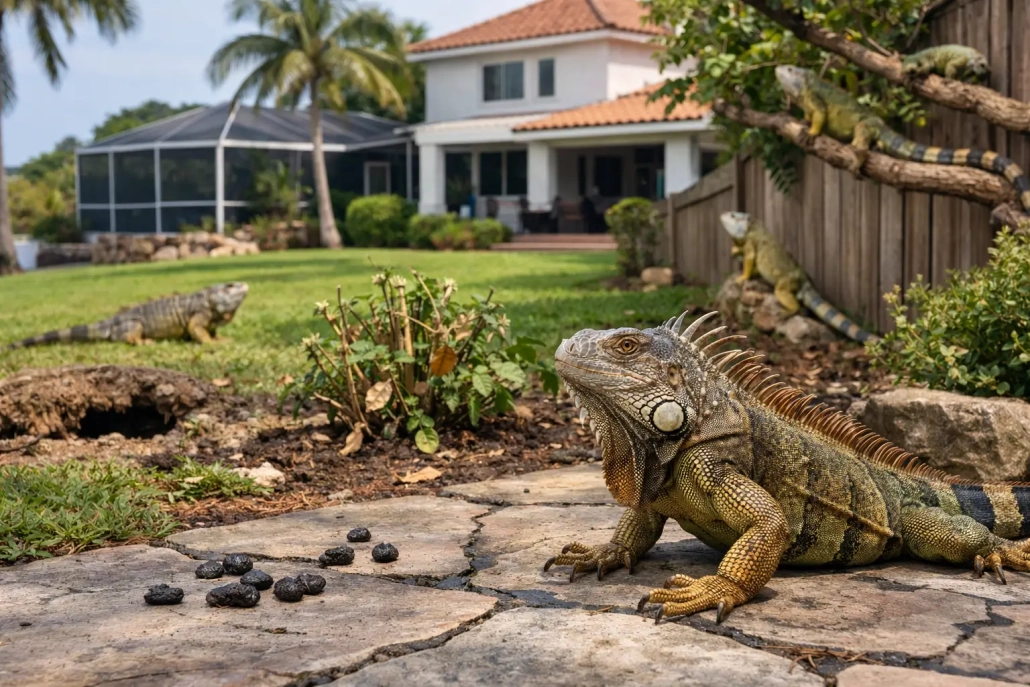
9 Signs of an Iguana Infestation on Your Property
A fresh hole beside a pool deck or seawall can look minor at first. Then rain hits, the soil shifts, and what seemed like a landscaping issue becomes a repair bill. In South Florida, the signs of an iguana infestation often show up around the parts of a property you can least afford to lose: foundations, walkways, seawalls, docks, landscaping, and outdoor mechanical equipment.
Green iguanas are invasive in Florida, and they do not need much time to turn a quiet yard, marina, golf course, or commercial site into a recurring problem. Seeing one iguana does not always mean you have an infestation. Seeing repeated activity, damage, droppings, or burrows is different. Here is what to watch for and when it is time to act.
1. Repeated Iguana Sightings in the Same Areas
An iguana crossing the yard once may be passing through. But if you see iguanas day after day around the same wall, canal edge, roofline, pool area, or landscaped bed, they have likely found food, sun, shelter, or a nesting location.
Look for patterns. Iguanas commonly gather in warm, open areas where they can bask, then retreat into dense vegetation, under decks, near rock piles, or into burrows when they are disturbed. On commercial properties, they may settle near loading areas, retention ponds, golf-course water features, marina infrastructure, and HVAC pads.
Large adults are hard to miss, but smaller iguanas matter too. A property with juveniles may have a nearby breeding population, which means the problem can grow quickly if it is ignored.
2. Fresh Burrows Near Structures
Burrows are one of the clearest signs of an iguana infestation and one of the most serious. Iguanas dig tunnels for shelter and nesting, usually in dry, sunny soil. A burrow may look like a round or oval opening in the ground with loose dirt pushed out in front of it.
Do not assume every hole belongs to an iguana. Rodents, crabs, and other wildlife can also leave openings. Iguana burrows are especially concerning when they appear beside a seawall, canal bank, foundation, driveway, pool deck, walkway, dock, or retaining wall.
The risk is not just the visible entrance. The hidden tunnel removes soil beneath or beside the structure. Over time, that loss of support can contribute to settling, cracks, erosion, and washouts. Along waterfront property, repeated burrowing can put pressure on a seawall system already dealing with water movement and saturated soil.
3. Cracked Pavers, Settling Soil, or Soft Spots
A new dip in the lawn, loose pavers near the water, or soil washing out around a deck deserves attention. These conditions do not prove iguanas are responsible, but they are common clues when burrows are nearby.
Walk the affected area carefully. If the ground feels hollow or gives slightly underfoot, stay off it until the area can be assessed. This is especially true near pool decks, seawalls, docks, and walkways used by guests, tenants, customers, or employees. A small cavity can become a safety problem without much warning after heavy rain.
Property managers should document the location and take dated photos before repairs cover the evidence. Fixing surface damage without addressing active wildlife activity can lead to the same repair being needed again.
4. Droppings on Decks, Docks, and Outdoor Living Areas
Iguana droppings are another obvious warning sign. They are often dark, pellet-like or tubular, and may have a white urate portion. You may find them on patios, pool coping, docks, boats, walkways, rooftops, balconies, and beneath favorite basking spots.
This is more than an appearance issue. Reptile waste can carry bacteria, including salmonella. That creates a sanitation concern around outdoor kitchens, pool areas, playgrounds, restaurant patios, marina walkways, and any surface where people or pets spend time.
Avoid sweeping dry droppings into the air or rinsing them toward storm drains and water features. Keep children and pets away from the area, wear gloves for cleanup, and wash hands thoroughly afterward. If droppings keep returning after cleanup, there is active iguana traffic nearby.
5. Damaged Landscaping and Missing Plants
Iguanas are not polite garden visitors. They feed on leaves, flowers, fruit, and tender new growth, often leaving ornamental beds stripped or unevenly damaged. Hibiscus, bougainvillea, orchids, flowering annuals, and vegetable gardens can all draw their attention.
The damage often appears as chewed leaves, broken stems, missing blooms, and plants that look repeatedly grazed from the ground up. Freshly planted beds are particularly vulnerable because they offer soft growth and exposed soil that is easy to dig.
Changing plants can reduce some feeding pressure, but landscaping changes alone rarely solve an established infestation. If iguanas have already claimed the property for shelter and nesting, they may simply move to another food source or another section of the yard.
6. Iguanas Around HVAC Equipment or Utility Areas
Outdoor mechanical areas offer warmth, cover, and protection from foot traffic. Iguanas may hide beneath condenser units, around utility boxes, behind equipment enclosures, or in vegetation surrounding HVAC pads.
This creates a practical problem for homeowners and facilities teams. Droppings, nesting material, digging, and animal activity can interfere with access for maintenance. In some cases, wildlife around electrical or mechanical equipment can contribute to damage and downtime. For a business, a disabled unit during South Florida heat is not a small inconvenience.
Do not reach under equipment or try to flush an iguana out yourself. A cornered iguana can bite, scratch, whip with its tail, or make a quick run into a more difficult area.
7. Scratching, Thumping, or Movement in Attics and Rooflines
Iguanas are strong climbers. They can get onto roofs, into dense tree canopies, and around elevated ledges where they find warmth and safety. If you hear unusual movement near a roofline, soffit, attic opening, or screened enclosure, investigate from a safe distance.
Not every roof noise is an iguana. Squirrels, rats, birds, and other wildlife can make similar sounds. The difference is often the supporting evidence outside: visible climbing marks, droppings below a wall or tree, iguanas basking on the roof, or repeated activity near a gap.
Roof and attic access needs prompt attention. Wildlife entry points can worsen over time, and a rushed DIY attempt can damage screens, vents, wiring, or roofing materials.
8. Burrow Activity During Nesting Season
Female iguanas can dig nesting tunnels in open soil, mulch beds, canal banks, and loose areas near structures. You may notice fresh excavation, soil piles, or a burrow that appears suddenly in a sunny location.
Nesting activity changes the urgency. Removing a visible adult while leaving active burrows and favorable conditions behind may not stop the cycle. A proper response considers where iguanas are entering, feeding, hiding, and digging – not just the one animal currently in view.
For larger properties, this is why a site-wide assessment matters. A golf course, marina, apartment community, or waterfront business may have several activity zones that need attention, not one isolated hole.
9. A Problem That Keeps Coming Back After DIY Efforts
Store-bought repellents, motion sprinklers, fencing, and home remedies may discourage occasional visitors. They can be useful around a small garden, but they have limits. They do not repair burrow damage, safely remove established iguanas, or address a population that has made your property part of its routine.
If you are filling the same holes, cleaning droppings every week, replacing plants, or seeing iguanas return after each attempt, the issue needs a more direct plan. The right approach depends on the property, the size of the activity area, nearby water, access points, and the condition of affected structures.
When to Call for Professional Iguana Removal
Call for help promptly when burrows are near a seawall, foundation, pool deck, driveway, dock, or other structure. The same goes for recurring droppings in guest areas, iguanas around equipment, or repeated sightings at a home or commercial property.
Professional removal is not about creating drama over one lizard. It is about stopping active damage before it becomes a larger structural, sanitation, or liability issue. A licensed and insured local team can assess the activity, remove nuisance iguanas safely, and help identify the conditions that are keeping them on site.
Florida Iguana Ops takes the straightforward route: show up, assess the problem, remove the iguanas, and help protect the property without gimmicks or runaround. If fresh holes or daily sightings are becoming normal on your property, do not wait for the next storm to show you what is happening underneath.



Leave a Reply
Want to join the discussion?Feel free to contribute!