
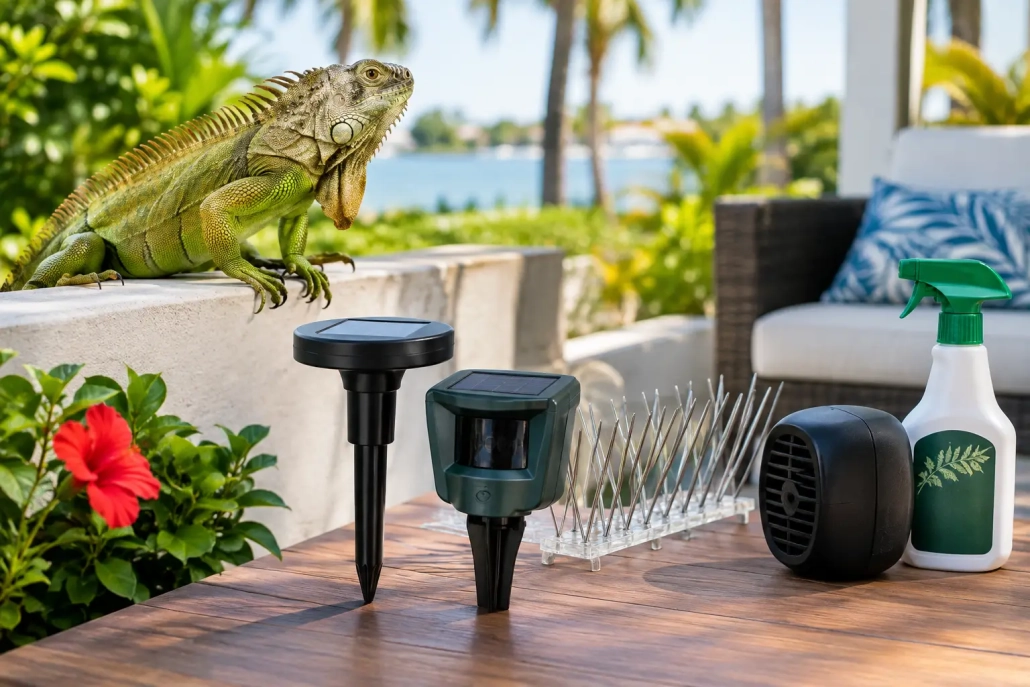
7 Best Iguana Deterrents for South Florida Patios
A patio should be where you drink your coffee, host family, or keep an eye on the pool – not where you find fresh droppings, chewed plants, and an iguana under the furniture. In South Florida, the best iguana deterrents for patios work by making the area less attractive while addressing the reason iguanas are already showing up.
That last part matters. A plastic owl may make a newly arrived iguana hesitate for a day. It will not solve an established problem when the animal has a warm hiding spot, easy food, water, and access to nearby burrows. If iguanas are repeatedly using your patio, pool deck, seawall, or landscaping, treat it as a property-protection issue, not a minor nuisance.
Why Iguanas Keep Returning to Patios
Patios give iguanas several things they look for. Pavers and concrete hold heat. Dense landscape beds, stacked materials, and open spaces beneath decks create cover. Pet food, fallen fruit, vegetable gardens, bird feeders, and ornamental plants can all supply food.
Water is another draw. Pool edges, fountains, irrigation runoff, and pet bowls offer a reliable drink, especially during dry conditions. Once an iguana learns that a patio is safe and predictable, it may return even after a temporary scare device has stopped working.
The concern is bigger than an unpleasant mess. Iguana droppings can carry bacteria, including salmonella. Burrowing near patios, walkways, pool decks, driveways, and seawalls can undermine soil over time. On commercial sites, iguanas can also damage landscaping and shelter around mechanical equipment. The longer the activity continues, the harder it is to make the site unattractive.
7 Best Iguana Deterrents for Patios
The most effective approach is not one product. It is a few practical changes that eliminate food, reduce shelter, and make the patio less comfortable for repeat visitors.
1. Remove food sources every day
Start with the simple things that keep iguanas coming back. Do not leave pet food or food scraps outside. Pick up fallen mangoes, berries, and other fruit promptly. Keep outdoor trash closed, and clean grilling areas after use.
Bird feeders can create a steady supply of dropped seed. If iguanas are active near the patio, move feeders away from the seating area or use a setup that limits spilled seed. A lush vegetable or herb garden beside the patio may also need protection, since iguanas readily feed on tender greens, flowers, and fruit.
2. Protect favored plants with barriers
Iguanas often target hibiscus, orchids, bougainvillea, vegetables, leafy ornamentals, and newly planted landscaping. A physical barrier around vulnerable plants is usually more dependable than a scent-based repellent.
Use sturdy garden fencing, wire mesh guards, or protected planter enclosures that prevent the animal from reaching the foliage. Make sure barriers are secured at ground level. An iguana does not need a large opening to reach a plant bed, and gaps can become easy entry points.
Plant protection will not remove an infestation by itself, but it stops your landscaping from functioning as an open buffet. That makes the rest of your deterrent plan more effective.
3. Cut back hiding places near the patio
Dense shrubs touching the patio, untrimmed ground cover, lumber piles, unused pots, and cluttered storage areas all give iguanas a place to wait out the heat or avoid people. Clear these areas so you can see beneath plants and around the edge of the slab.
Keep mulch beds neat and avoid leaving large gaps beneath raised decks, sheds, or outdoor cabinets. If an iguana can disappear under a structure, it is much harder to discourage it from using the property. Closing off access only works after you are sure no animal is trapped inside.
This is especially important along pool equipment pads and outdoor HVAC units. Iguanas may use the protected space around equipment for cover, while droppings and digging create an extra maintenance problem.
4. Use motion-activated water strategically
Motion-activated sprinklers can be useful for patios, garden edges, and travel routes where iguanas regularly enter. A sudden burst of water is a humane interruption and can make an open area feel less predictable.
Placement is everything. Aim the sensor at the route the iguana uses rather than the middle of the patio. Test it before relying on it, and expect to adjust it for wind, plant growth, or other animals.
This option has limits. It may not be practical around doors, guest walkways, delicate outdoor furniture, or areas where people regularly pass through. It also will not stop an animal that has an established den or a strong food source nearby. Think of it as reinforcement, not the whole plan.
5. Add visual deterrents, but rotate them
Reflective tape, moving pinwheels, and predator decoys may discourage an iguana that is passing through. They are inexpensive and can be worthwhile around a garden bed or the perimeter of a patio.
The trade-off is habituation. Iguanas are not fooled for long by an object that never changes. A stationary owl on the fence becomes part of the scenery. If you use visual deterrents, move them regularly and combine them with food removal and habitat cleanup.
Avoid spending heavily on gimmicks that promise a permanent fix. There is no single ultrasonic device, spray, or decoy that reliably clears a well-established iguana problem from a South Florida property.
6. Repair access points and watch for burrows
Walk the patio perimeter after heavy rain and look for loose soil, fresh digging, cracks opening near edges, or holes beneath pavers and slabs. Iguanas commonly burrow in soft soil near structures, landscape borders, seawalls, and retaining areas.
Do not simply pack an active burrow with soil and assume the problem is over. The animal may dig out, shift to a nearby location, or leave young underground. Repeated burrowing near a patio, foundation, pool deck, or seawall deserves professional attention because the issue can extend beyond what is visible at the surface.
Once active animals have been removed and the area has been evaluated, repair and exclusion work help prevent the same route from becoming a repeat problem.
7. Remove established iguanas professionally
Deterrents work best before iguanas settle in. If you are seeing the same large iguana daily, finding frequent droppings, hearing movement under a deck, or spotting active burrows, the property likely needs more than prevention measures.
Professional removal addresses the animals already using the site, then allows deterrence and exclusion to work as intended. It also keeps property owners from trying risky DIY methods around pools, elevated decks, seawalls, or commercial equipment. Wildlife rules and humane handling requirements still apply, and a licensed, insured local provider can handle the work without guesswork.
Florida Iguana Ops helps property owners identify activity areas, remove nuisance iguanas, and focus on the conditions that invite them back. For larger properties, marinas, golf facilities, and commercial sites, a targeted plan is often far less costly than waiting for damage to spread.
What Not to Rely On
Strong-smelling home remedies are often more trouble than they are worth. Pepper mixtures, ammonia, mothballs, and harsh chemicals can create risks for children, pets, plants, and nearby wildlife without solving the underlying issue. Mothballs should never be used outdoors as an animal deterrent.
Avoid trying to chase, grab, poison, or trap iguanas without the proper knowledge and legal guidance. An iguana can bite, scratch, whip with its tail, or drop from a tree when startled. More importantly, a rushed attempt can push the animal into a wall void, under a deck, or into another part of the property.
When Patio Iguana Activity Becomes Urgent
Call for help promptly if you see soil collapsing near a patio edge, pool deck, foundation, driveway, seawall, or retaining wall. The same goes for repeated burrows, large groups of iguanas, droppings near food-service areas, or signs of animals around HVAC and electrical equipment.
For homeowners, a few droppings may be the first warning. For property managers, the issue can affect guest safety, sanitation, landscape budgets, and maintenance schedules. Fast action is usually simpler than trying to recover after a burrow has compromised pavers or erosion has reached a structural edge.
A clean, open patio with protected plants and no easy food source gives iguanas fewer reasons to stop. If they have already made your patio part of their routine, deal with the animals first, then make the space one they have no reason to revisit.



Leave a Reply
Want to join the discussion?Feel free to contribute!